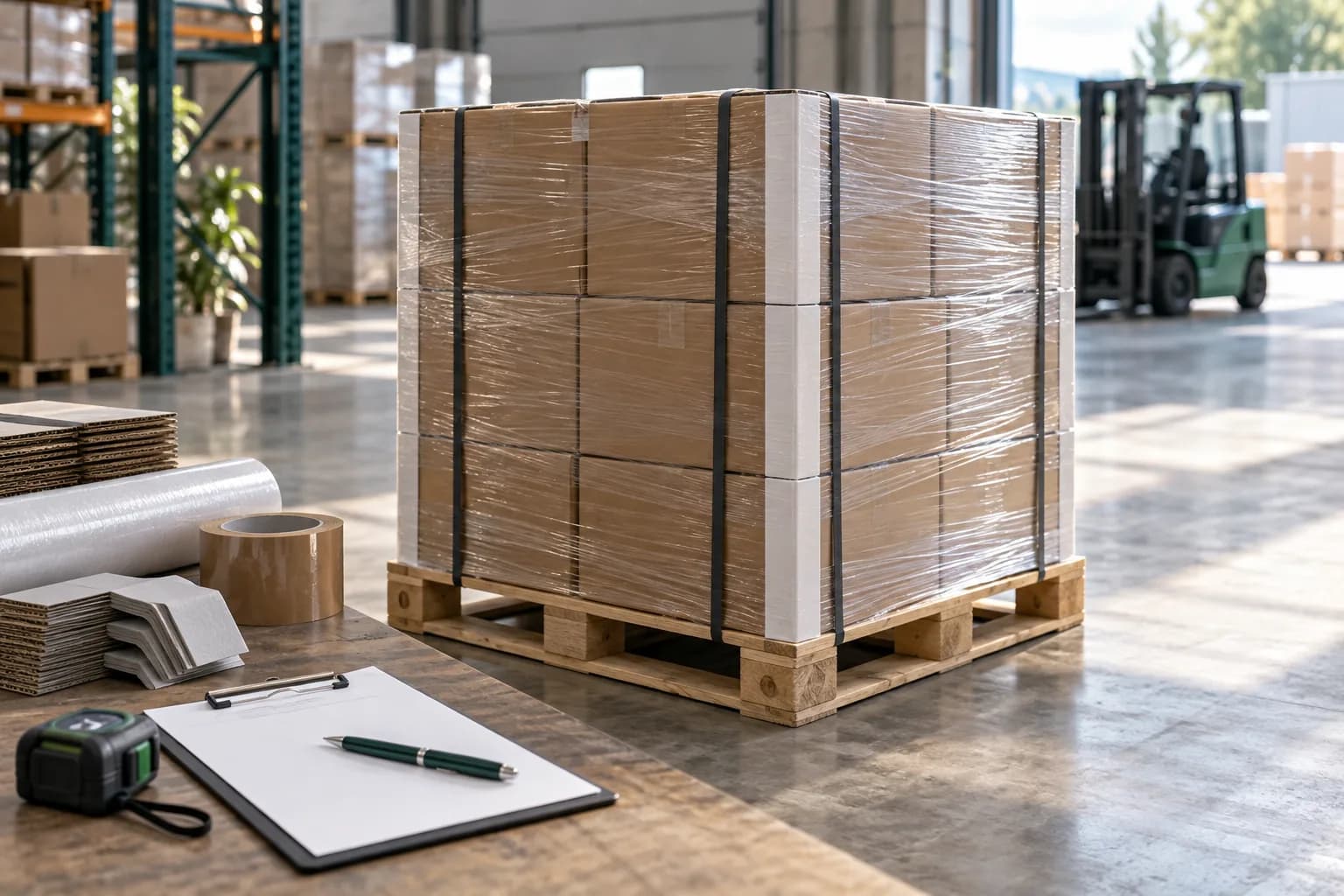
Palletised cargo packaging: what to prepare before shipping
How to prepare palletised cargo: check the pallet, measure dimensions including packaging, agree stackability and loading, and record its condition before handover.
Author: GreenTrans Group Editorial Team
First describe the consignment and its route to the consignee
A single shipment profile is a useful starting point for preparing palletised cargo. Record what the boxes contain, how many finished units there will be, when packing will be complete and who is responsible for release. Clarify fragility, moisture sensitivity, protruding parts and restrictions on the goods' orientation. The word 'equipment' without a description is not enough to select suitable protection.
Before packing, find out the conditions at both the shipper and consignee: whether there is a loading dock and forklift, how the vehicle approaches the gate, and whether an unloading appointment is needed. If groupage is planned, clarify the warehouse handling stages. Give the packer the arrangement that has actually been agreed: package requirements must account for the entire journey and handovers between participants.
Check the base before stacking the boxes
Select the pallet for the specific cargo and handling method. Check its model, the manufacturer's stated load capacity and its suitability for the equipment being used. Do not apply one pallet type's specifications to every wooden pallet of a similar size. Inspect the base from all accessible sides before boxes conceal any defects.
EPAL's criteria specifically identify missing or broken boards, damaged blocks, rot and contamination that could transfer to the goods. For EPAL, these indicate issues with usability and exchangeability. If the base's condition is doubtful, arrange replacement or a professional inspection; wrapping in film does not restore a damaged structure.
Agree packaging for the entire handling unit
A product box and a finished transport unit serve different purposes. DHL's palletising guidance recommends placing boxes without overhanging the base edges; protruding areas remain vulnerable during handling. Choose the stacking pattern with the strength of the boxes and contents in mind. A level top helps with load arrangement but does not in itself prove the strength of the entire package.
Ask a packaging specialist to determine suitable corner protectors, separators, external protection and means of unitising the cargo on the pallet. For an irregularly shaped item, send a drawing or photographs with dimensions in advance. State in the brief which elements must not be compressed, used as supports or covered with material. Do not choose the number of film layers based on a random example from another shipment.
Measure the finished pallet including packaging
For a rate request, measure the maximum external length, width and height of each finished unit. Measure height from the pallet's lowest point to the highest point of the cargo or protection. State gross weight: the goods together with the pallet and all packaging materials. If the units differ, list each size and its quantity on a separate line.
For a rectangular unit, geometric volume equals length × width × height in metres. For example, actual measured dimensions of 1.20 × 0.80 × 1.50 m give 1.44 m³; three identical units give 4.32 m³. This is a calculation example, not a universal pallet size. Volume does not automatically determine the rate: also provide weight, stackability and handling requirements. Measure again after adding a wooden crate or other protection.
State stackability and moisture sensitivity separately
Ask the goods manufacturer or packer whether a top load is permitted, its limit and the conditions under which it may be applied. If there is no confirmation, state explicitly in the enquiry: 'Stacking has not been agreed.' The consignee and carrier must understand the restriction in the same way. Clarify which markings and instructions are needed on each unit; a verbal agreement with the driver alone is not enough to pass the information along the entire chain.
Internal humidity also matters during a long enclosed journey. UNECE's CTU Code Annex 3 lists its sources: the cargo itself, timber components, pallets, porous packaging and moisture introduced during loading. Condensation can damage goods and cardboard. Discuss the cargo's initial condition, expected route conditions and suitable protection with the packer; adding an outer layer of film does not confirm that the moisture issue has been resolved.
Distinguish packaging from securing the load in the vehicle
Combining boxes on a pallet does not replace positioning and securing the pallet itself in the load space. The CTU Code treats loading and securing as a separate professional field that takes the transport chain into account. Before the vehicle arrives, agree who is responsible for these operations, what information the responsible specialist needs and whether the finished packaging is compatible with the chosen transport method.
Report any offset centre of gravity known from the documentation, any no-tilting requirement and the permitted lifting methods. If special equipment is needed, arrange it with both sites in advance. This information profile helps organise the work; calculations of forces, selection of securing equipment and its installation plan must be carried out by a competent specialist for the specific cargo.
Record the cargo's condition at handover
Before release, the editorial team recommends taking an overall photograph of each unit, plus photographs of accessible sides, the base and markings. Link the images to the shipment number and unit, and retain the date. Check that numbers are legible, information matches the list being handed over, and the consignee has received the current dimensions and restrictions.
If damage, signs of moisture or a quantity discrepancy are found at handover, pause acceptance of the disputed unit for a joint inspection and contact the responsible parties. Record the observed discrepancy in the agreed handover document and attach photographs; determine further action under the contract. To discuss preparation with GreenTrans, send the consignment profile, photographs and conditions at both sites: the exact scope of work must be agreed before dispatch.
Frequently asked questions
Should the pallet be included in the cargo's weight and height?
Yes. For a quote, provide the gross weight and full external dimensions of the finished package, including the pallet, packaging and protective elements. If packing is not yet complete, mark the information as provisional and update it before the vehicle arrives.
Can cargo be considered stackable if its top is flat?
A flat top alone is not enough. Confirmed loading limits and conditions for the packaging and goods are needed. If it is not known whether other cargo can be placed on top, say so when requesting a quote and agree the status before shipping.
Is wrapping a pallet in stretch film enough?
The way boxes are combined into a handling unit should be chosen according to their properties and handling conditions. Wrapping alone does not confirm shipment readiness or replace a separate decision on positioning and securing the pallet in the vehicle.
Sources and reference materials
- Palletised cargo packaging and preparation basics — DHL Global Forwarding
- EPAL Euro Pallet: specifications and condition criteria — European Pallet Association
- CTU Code: scope of the loading and securing guidance — International Maritime Organization
- CTU Code, Annex 3: sources of moisture and condensation damage — UNECE
Rules and rates change. Before shipping, check the latest versions of the documents and the requirements for the specific goods, route and date.
Related articles
LTL or FTL: how to choose transport for a consignment
Groupage or a dedicated vehicle: transit time, transloading and delivery acceptance compared, with an example and questions for comparable quotes.
How the cost of FTL transport is calculated
What goes into a full truckload quotation: route, vehicle, loading, waiting time, toll roads, special requirements and documents.
Related services
Visit the relevant service or route page to review the transport arrangements and submit an enquiry.