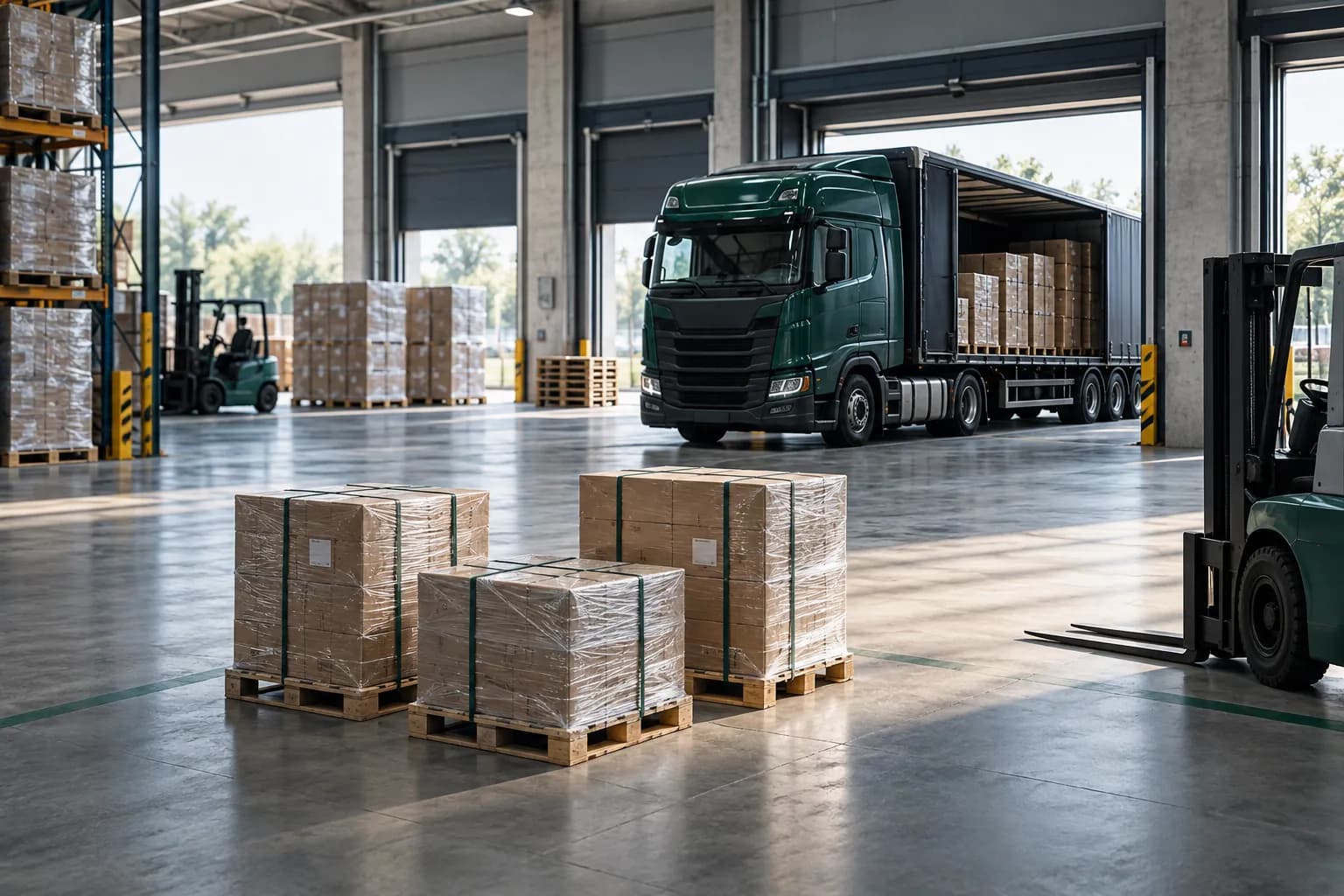
LTL or FTL: how to choose transport for a consignment
Groupage or a dedicated vehicle: transit time, transloading and delivery acceptance compared, with an example and questions for comparable quotes.
Author: GreenTrans Group Editorial Team
What the customer chooses: space in a truck or a dedicated vehicle
LTL, Less Than Truckload, uses part of a vehicle's capacity alongside other customers' shipments. With FTL, Full Truckload, the vehicle is allocated to one customer's cargo. The load space does not have to be completely filled: the choice concerns how transport is organised, not the percentage of space occupied.
DHL separately describes PTL, a part load, between groupage and full-load arrangements; DSV also distinguishes full load, part load and groupage. It is therefore more useful to state in the enquiry whether other cargo, transloading and intermediate stops are permitted than simply to use an abbreviation.
Why a universal pallet-count threshold is not enough
For an initial choice, describe each package after packing: length, width, height, gross weight and whether other cargo can be placed on top. PEK notes the relationship between stackability and use of cargo space. Two consignments with the same pallet count are therefore not necessarily comparable.
The editorial team suggests this sequence: first eliminate unsuitable handling options, then compare the remaining offers. Four low pallets of boxes and four tall packages with protruding machinery call for different questions. Instead of following a rule that 'above a certain weight, always use FTL', request both arrangements using the actual dimensions and photographs.
Examine the cargo's journey between the two addresses
In its description of international groupage, PEK identifies consolidation, main transport, separation of consignments and last-mile delivery. This is an example of a specific chain, not a mandatory route for every LTL shipment. Ask the carrier to list the stages of your particular offer and identify where the cargo is unloaded from the vehicle.
For each such location, ask three questions: does the packaging allow the handling involved, who accepts the consignment, and how is its condition recorded? If the shipper's process rules out transloading, state this condition before the quote is prepared. Separately agree whether other cargo is allowed in the vehicle: a ban on transloading and a ban on co-loading address different needs.
Check delivery acceptance first, then choose the transit time
Ask the consignee for the actual receiving window, the deadline for requesting site access and any site restrictions. State whether a loading dock, forklift and turning space are available. An offer that gets the cargo to the right city on time may still be unsuitable for a particular warehouse's conditions.
The editorial team recommends comparing the ready date at the shipper and the handover date to the consignee, along with the confirmed unloading appointment process. Clarify whether collection and delivery to the address are included in the stated transit time. The term FTL alone does not guarantee arrival by a particular hour; the required commitment must be agreed separately.
Example: one consignment, two different solutions
Training scenario: a supplier ships six pallets of components from Moscow to Voronezh. Each packed unit measures 1.2 × 0.8 × 1.1 m and has a gross weight of 250 kg. The total is 1,500 kg and 6.336 m³. These are example inputs, not a capacity standard or a real GreenTrans shipment.
If the warehouse accepts the goods over several agreed days, the packaging allows the proposed handling and other cargo is permitted, it makes sense to include an LTL quote in the comparison. Suppose a new condition emerges: the components are needed for a single installation shift and the shipper prohibits repeated handling of the packaging. Then request a suitably sized dedicated vehicle and confirmation of the required delivery arrangement.
The consignment volume has not changed, but the decision criterion has. Do not select a winner before the carrier responds: an available direct part-load option may also meet the conditions. The decision should follow from the confirmed route and delivery acceptance, not the service name.
How to compare two quotations
Create two columns, one for groupage and one for a dedicated vehicle, using identical addresses, ready date and package descriptions. List collection, main transport, terminal handling, delivery to the address, loading and unloading in separate rows. Against each operation, mark whether it is included, charged separately or carried out by your side.
Then record the conditions that change the offer: revised dimensions, a new date, an additional address or waiting at a warehouse. Compare the total for the same outcome. Keep your internal assessment of the consequences of delay separate from the rate: it is your management assessment, not compensation promised by the carrier.
What information to provide when choosing an arrangement
Prepare a single shipment profile: warehouse addresses and contacts, ready date, receiving window, goods description, package count, and the dimensions and weight of each package after packing. Add photographs and information on stackability and loading method. State separately whether transloading and other cargo are permitted, and any temperature or other special conditions.
In your enquiry to GreenTrans, you can ask for a comparison of LTL and a dedicated vehicle using these details. Specify your priority: minimum cost within an acceptable transit time, an agreed receiving window or a particular handling process. Before confirming the order, check that the selected offer covers those exact conditions.
For regular shipments, keep a record of planned and actual receipt dates, the number of cargo handling operations and total costs. Discuss any deviations with the logistics specialist after the first shipment. This log will provide a basis for retaining or changing the arrangement for the next consignment; one successful delivery alone does not prove that an option suits a different cargo.
Frequently asked questions
Can I book a dedicated vehicle for two pallets?
Yes. Dedicated transport can also be chosen for a small consignment when the schedule or handling conditions require it. Request a vehicle with suitable capacity and compare it with the available groupage arrangement: a half-empty large truck should not be the only option quoted.
Does LTL necessarily mean transloading at a warehouse?
The label alone is not enough. Clarify whether the offer is terminal-based groupage or a part load with a different routing arrangement. Before booking, ask for a list of the operations involving your consignment and agree a no-transloading condition if one is necessary.
How can offers be compared if one ends at a terminal?
Ask for both quotes to cover the same consignee address. For the terminal option, add the agreed costs of collection, handling and onward delivery, as well as the responsible employee's time. Otherwise, the comparison does not cover the same outcome.
Sources and reference materials
- LTL, PTL and FTL: differences between road freight options — DHL
- Full loads, part loads and groupage: distinct road freight formats — DSV
- Groupage: consolidation, delivery stages and the effect of packaging — PEK: GLOBAL
Rules and rates change. Before shipping, check the latest versions of the documents and the requirements for the specific goods, route and date.
Related articles
Volvo starts production of new electric trucks: checks before booking freight
Volvo has announced series production of a new generation of electric trucks. Questions to ask about the route, charging and load when choosing freight transport.
E40 at Bertem: planned 10–11 October closure and freight preparation
A closure of the E40 in Belgium is planned for bridge installation. How to coordinate the route, unloading slot and time allowance for an October shipment.
How the cost of FTL transport is calculated
What goes into a full truckload quotation: route, vehicle, loading, waiting time, toll roads, special requirements and documents.
Palletised cargo packaging: what to prepare before shipping
How to prepare palletised cargo: check the pallet, measure dimensions including packaging, agree stackability and loading, and record its condition before handover.
Related services
Visit the relevant service or route page to review the transport arrangements and submit an enquiry.