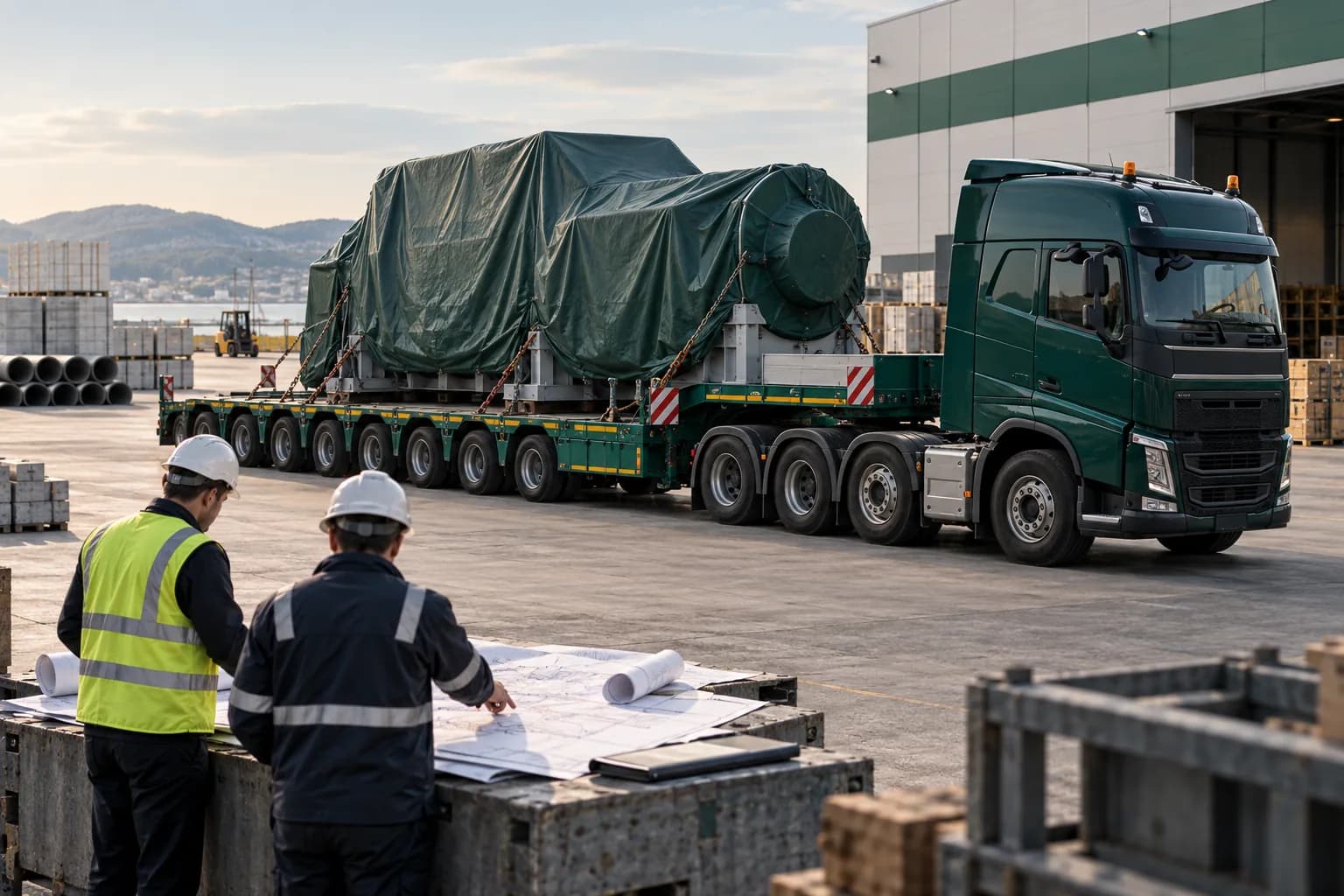
Oversized cargo: the data needed for route planning and approval
A vehicle with its load may be up to 2.55 m wide and 4 m high. When cargo becomes oversized and what details a quote and a permit need.
Author: GreenTrans Group Editorial Team
Prepare a single cargo specification sheet
A request to ‘move a machine from one city to another’ is a starting point, but leaves too many unknowns for an agreed price. Prepare one shipment specification sheet: what is being transported, in what condition, from where to where, and when it will be ready. Attach manufacturer information and contact details for staff at both sites.
This article provides an editorial checklist for the customer. It helps communicate the initial data to the carrier. Qualified specialists select the vehicle and assess loads, the route and working methods; the customer's role is to provide reliable information and agree who will supply missing data.
Distinguish cargo dimensions from loaded vehicle specifications
The published text of Rules No. 2060 lists cargo characteristics and vehicle specifications separately. It specifies dimensions and weight for the cargo; for the vehicle combination it also specifies axle loads, axle spacing and other characteristics. A statement such as ‘equipment three metres high’ therefore does not describe the vehicle in its loaded state.
Ask the person preparing the cargo to confirm the length, width, height and weight of each unit in its transport configuration. Include packaging, supports and protruding parts. State the unit of measurement and source for each value: measurement, weighing or a document. Clearly mark estimates instead of rounding them to a convenient figure.
Permitted dimensions: 2.55 m wide, 4 m high
Annex 1 to the Rules for the carriage of goods by road (Russian Government Resolution No. 2200) sets the permitted dimensions of a vehicle with its load: width 2.55 m, or 2.6 m for insulated bodies; height 4 m from the road surface; length 12 m for a single vehicle or trailer and 20 m for a road train. If the loaded vehicle exceeds any one of these, the shipment counts as oversized and requires a special permit.
Dimensions are measured at the outermost points of the vehicle with its load, not the cargo alone: the height is the deck height plus the cargo, and the width is taken at the widest projecting part. The limits are revised from time to time, so before fixing a dispatch date ask the carrier which edition is in force and what the transit countries require.
Collect drawings, photographs and manufacturer information
Provide an overall dimensioned drawing and photographs from several sides, including the base and protruding parts. Ask the manufacturer for the centre of gravity, permitted lifting and support points, transport orientation and handling restrictions. If this information is unavailable, assign a separate task to obtain it or have competent specialists determine it.
Clarify which assemblies have already been removed, which may be dismantled, and who has confirmed the selected configuration. Add a description of sensitive surfaces and requirements for protection from precipitation. Photographs help explain the structure but do not replace confirmed measurements or an engineering diagram. Do not choose lifting sling points yourself based on the equipment's appearance.
Describe access to the actual unloading location
Give exact addresses, entrance coordinates and the cargo placement location. Ask the sites to report known restrictions: gates, arches, turns, gradients, road surfaces and overhead obstructions. Add entrance photographs and a site plan, the photograph date and the contact details of someone who can show the route on site.
The Ministry of Transport describes an electronic route planner that takes road restrictions into account. Our editorial recommendation is to discuss separately with the carrier whether access roads and sites need surveying. A location marked in an ordinary navigation app does not confirm that the selected vehicle combination can pass; uncertain sections should be checked before agreeing vehicle arrival.
Separate site preparation from cargo handling
Agree loading and unloading as separate stages. Who provides equipment and personnel, who prepares the site, and who checks whether the machinery can be set up? Put these questions to the sender and recipient in advance. One warehouse's confirmation does not mean the other is ready, even if it has handled the cargo before.
Ask specialists to determine the handling method and requirements for supports, positioning and securing. Record access times, passes, those responsible for admission and the procedure for communication in case of delay in the order. Do not specify strap or chain quantities or crane capacity using a general internet checklist: these decisions must relate to the particular cargo and working conditions.
Clarify permit requirements before setting the dispatch date
Rules No. 2060 tie the special permit to the vehicle and route. A permit may be required for the planned shipment; a competent carrier must check its precise applicability and necessary approvals against the requirements in force. The document copy used below is dated 2024 and does not replace this check for the date of travel.
Request a written response stating who is responsible for documents, what initial data are still needed, whether an escort is required, and the conditions under which a vehicle can be supplied. Do not equate an application submitted with a permit issued. Until the necessary conditions are confirmed, keep the date provisional and agree a fallback production schedule.
Compare quotations with the same scope of work
To compare prices, send every participant the same version of the cargo specification sheet. Ask for a breakdown of the quotation: transport, vehicle positioning, loading and unloading, route preparation, approvals, escorts and additional work where required. Clarify separately which costs are included, which will be determined after a survey, and how taxes are treated.
Record the quotation's validity period and the circumstances requiring revision: a changed configuration, new dimensions, a different address or a delay in site readiness. This detail helps compare proposals with different conditions. The lowest initial figure without a scope of work does not provide a clear budget for the entire shipment.
Information pack for an initial discussion with GreenTrans
Prepare a sheet with the equipment name, number of units, confirmed dimensions and weight, packaging description, drawings and photographs. Add addresses and entrance coordinates, site information, loading and unloading readiness, your preferred date and the responsible contacts. List unknown values separately and state who will clarify them.
Send this pack through GreenTrans's contact channels to discuss oversized transport. Feasibility, scope of work, documents, cost and timing are confirmed for the specific enquiry. After any change to the cargo or site, send an updated, dated specification sheet so that all participants use the same information.
Frequently asked questions
What cargo width and height are permitted for road transport?
Under Annex 1 to the Rules for the carriage of goods by road (Resolution No. 2200), a vehicle with its load may be up to 2.55 m wide (an insulated body up to 2.6 m) and up to 4 m high from the road surface, and a road train up to 20 m long. Exceeding any of these makes the shipment oversized and requires a special permit. Check the edition in force on the date of transport.
Are the machine model and catalogue weight enough for a final quotation?
They are useful for an initial discussion. Approval requires the actual configuration, dimensions and weight of the transport unit, packaging, manufacturer documentation and site conditions. Indicate which data have been measured and which still need confirmation.
Can the need for a special permit be determined from cargo width alone?
That single value is not enough to assess the entire shipment. Give the carrier the cargo specifications: they must assess the selected loaded vehicle, weight, axle loads, route and applicable conditions.
What should I do if the packaging or unloading address changes before loading?
Notify the person responsible for transport immediately and wait for confirmation of the revised conditions. The impact on dimensions, positioning, route, documents, price and agreed vehicle arrival date will need to be checked.
Sources and reference materials
- Rules for the movement of heavy and oversized vehicles, Resolution No. 2060: copy dated 19 December 2024 — Kuzbass Road Directorate, State Public Institution
- Electronic issuance of special permits and route planning: announcement of 1 August 2025 — Russian Ministry of Transport
- Rules for the carriage of goods by road, Russian Government Resolution No. 2200 of 21 December 2020, Annex 1 — GARANT.RU legal information portal
Rules and rates change. Before shipping, check the latest versions of the documents and the requirements for the specific goods, route and date.
Related articles
Palletised cargo packaging: what to prepare before shipping
How to prepare palletised cargo: check the pallet, measure dimensions including packaging, agree stackability and loading, and record its condition before handover.
How the cost of FTL transport is calculated
What goes into a full truckload quotation: route, vehicle, loading, waiting time, toll roads, special requirements and documents.
M-12: where a weighing and dimension-control test is planned
Avtodor is testing automatic weight and dimension control at three points on the M-12 from 1 October. Where they are and what carriers should check.
Related services
Visit the relevant service or route page to review the transport arrangements and submit an enquiry.