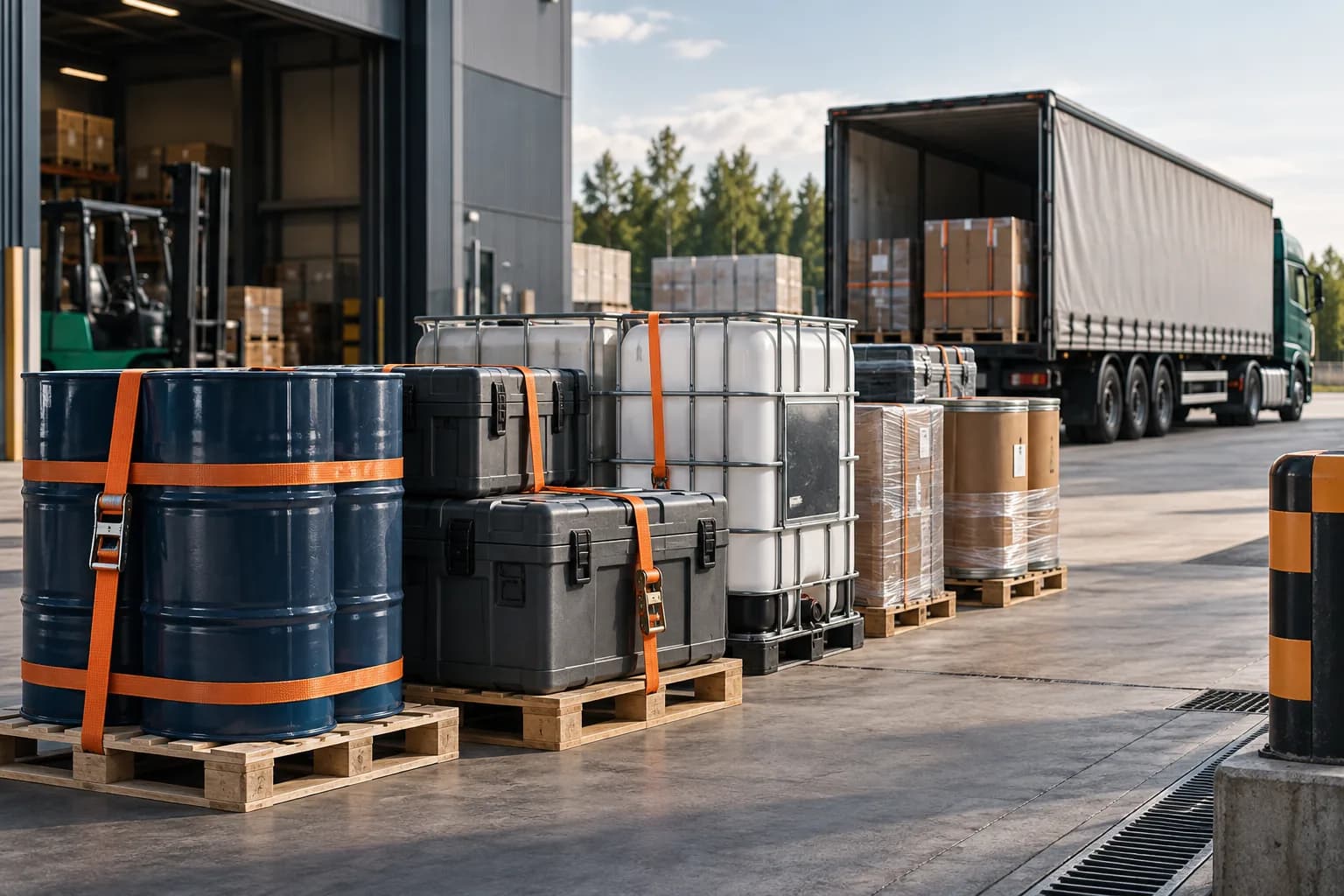
ADR cargo: hazard classes and preparation for transport
ADR is the international agreement on the carriage of dangerous goods by road. Nine hazard classes, UN number, documents, packaging and marking.
Author: GreenTrans Group Editorial Team
What ADR regulates
ADR is the international agreement concerning the carriage of dangerous goods by road. Annex A covers classification, packaging, marking, documents and conditions of carriage; Annex B covers requirements for vehicles, crews and operations. ADR 2025 applies from 1 January 2025 and remains the baseline for checking international road transport in 2026.
‘Chemicals’ or ‘dangerous goods’ is not enough. Requirements depend on the exact substance or article, UN number, proper shipping name, class, subsidiary hazard, packing group, quantity, packaging and route. An error in one element changes the documents and permissible transport conditions.
The nine hazard classes: a brief guide
The system includes explosive substances and articles; gases; flammable liquids; flammable solids, self-reactive substances and substances that emit flammable gases; oxidising substances and organic peroxides; toxic and infectious substances; radioactive material; corrosive substances; and miscellaneous dangerous substances and articles.
The class is only the starting point. Within it, dangerous-goods list entries, classification codes, packing groups and special provisions apply. For some cargo, control temperature, environmental hazards, tunnel restrictions or special packaging requirements matter. Classification cannot be determined from a product's everyday name.
UN number, shipping name and packing group
The UN number identifies the transport entry but must be used together with the proper shipping name. A brand's commercial name or internal item code does not replace that name. Where an entry has a subsidiary hazard or technical name, these details must also be taken into account in documentation and marking.
The packing group, where assigned, reflects the degree of danger and affects permitted packaging. Within the applicable classification, I corresponds to high danger, II to medium danger and III to lower danger. Some classes use other parameters and are not assigned a packing group, so an empty field is not always an error.
Documents and initial information from the consignor
The consignor supplies transport data to the carrier in the prescribed way: UN number, shipping name, class and, where applicable, packing group, tunnel restriction code and other mandatory elements. The safety data sheet is a source of technical information, but alone does not prove that the transport document entry is correct.
The order also needs the number and type of packages, weight or volume, addresses, a responsible contact, temperature conditions, whether mixed loading is possible and any exemptions the consignor intends to use. If the data conflict with the label, safety data sheet or actual packaging, stop loading until the discrepancy is clarified.
Packaging, marking and labels
Packaging must be permitted for the specific cargo and transport regime, be in serviceable condition and be closed in the prescribed manner. For combination packaging, check inner receptacles, absorbent material, material compatibility and outer packaging. A similar-looking jerrican without a confirmed packaging type is not sufficient.
Packages must bear the required numbers, hazard labels, orientation arrows and additional markings. Containers, tanks or vehicles may require plates and placards. Marking must remain visible and match the document throughout the route.
Vehicle, equipment and driver
Select the vehicle type after classification and quantity assessment. Some transport requires vehicle approval, special equipment, fire extinguishers, personal protective equipment and instructions in writing. The required equipment depends on the regime, not a general ‘ADR truck’ label.
The driver must have training and a certificate where the applicable provisions require them. Before departure, check document validity, equipment compliance, route restrictions, parking and emergency procedures. Do not assign a vehicle first and then try to adjust the classification to suit the equipment available.
Limited quantities and other exemptions
ADR provides several conditional exemptions: limited and excepted quantities, carriage within thresholds per transport unit, and special provisions for individual entries. Each regime has its own limits, packaging, marking and duties. Together they do not create a universal rule that ‘ADR is not needed below one tonne’.
To use an exemption, document the calculation and check the entire load. If a vehicle carries several entries, account for every category and compatibility. Changes in quantity, packaging or groupage composition may put the transport outside the selected regime, so repeat the check before loading.
ADR transport enquiry checklist
Provide the UN number, full shipping name, class, subsidiary hazard, packing group, tunnel code where assigned, net and gross weight, number and type of packages, safety data sheet and photographs of markings. State the addresses, date, warehouse contact, loading arrangements and anticipated restrictions.
GreenTrans Group will check route feasibility and vehicle selection only after receiving these data. A link to the ADR service is provided below; if the dangerous goods form part of an import or multimodal chain, also describe the origin country, borders and transshipments. Final requirements are confirmed against the current ADR edition for the specific shipment.
Frequently asked questions
What data are required for an ADR transport quotation?
Provide the UN number, proper shipping name, class and subsidiary hazard, packing group where assigned, quantity, packaging type, weight, safety data sheet, addresses and route. Additional ADR information may be needed for a precise assessment.
Does a safety data sheet replace transport classification?
No. A safety data sheet helps provide information about the substance, but the consignor must supply correct transport data. These are checked against the applicable ADR edition for the specific substance, article, quantity and packaging.
Does a small quantity always exempt a shipment from ADR requirements?
No. Relief for limited, excepted and other quantities has specific conditions for the substance, packaging, marking and total load. It cannot be applied simply because the shipment seems small.
Can different dangerous goods be carried together?
Sometimes, but compatibility, mixed-loading prohibitions, separation, securing and quantity restrictions must be checked. The decision is based on each cargo's classification and the applicable ADR provisions.
Is a specially trained driver required?
For transport subject to the relevant ADR requirements, the driver and vehicle must meet the prescribed conditions. Any exemption or special regime must be checked before assigning a vehicle.
Sources and reference materials
- Agreement concerning the International Carriage of Dangerous Goods by Road (ADR 2025) — UNECE
- ADR 2025 Volume 1 — UNECE
- UN Model Regulations Rev. 24 (2025) — UNECE
Rules and rates change. Before shipping, check the latest versions of the documents and the requirements for the specific goods, route and date.
Related articles
Cargo delivery from China in 2026: routes, transit times and documents
A practical guide to road and multimodal shipping from China: route selection, initial data, documents, packaging and risk control.
How the cost of FTL transport is calculated
What goes into a full truckload quotation: route, vehicle, loading, waiting time, toll roads, special requirements and documents.
Related services
Visit the relevant service or route page to review the transport arrangements and submit an enquiry.